2025.11.25

Proposed by Clara Driaï-Allègre

Meirhaeghe, N., Sohn, H., & Jazayeri, M. (2021). A precise and adaptive neural mechanism for predictive temporal processing in the frontal cortex. Neuron, 109(18), 2995-3011.e5. https://doi.org/10.1016/j.neuron.2021.08.025

In this study, the authors demonstrate that in monkeys, the neural dynamics of the dorsomedial frontal cortex adjust their speed based on the expected mean interval of upcoming events. When a longer interval is anticipated, the neural activity evolves more slowly; conversely, when a shorter interval is expected, it speeds up. This variation in speed enables neurons to encode deviations from expectations (for example, distinguishing between early and late events) rather than simply tracking absolute time. Additionally, when the temporal distribution changes covertly, the neural dynamics adapt to reflect the new mean, suggesting an adaptive mechanism that aligns with the concept of predictive processing of time.
2025.02.04

Proposed by Clara Driaï-Allègre

Koppen, J., Bayones, L., Runge, M., Klinkhamer, I., & Narain, D. (2024). Cerebellar encoding of prior knowledge of temporal statistics. bioRxiv (Cold Spring Harbor Laboratory). https://doi.org/10.1101/2024.08.19.608550

A cerebellar cortical mechanism for learning temporal statistics

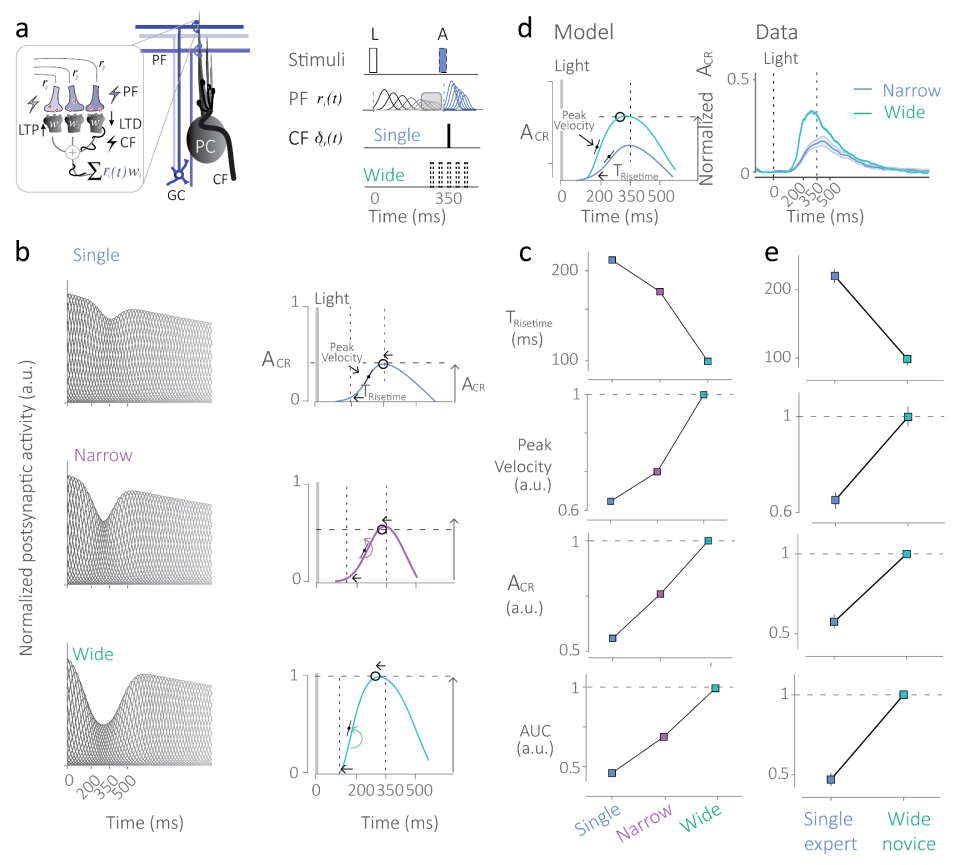
This study focuses on predictive eyeblink conditioning, investigating how eyelid movements adapt to environmental uncertainty and the probabilities of events. Researchers observed that predictive eyeblinks adjusted according to the timing of stimuli presented. The study highlights the role of cerebellar Purkinje cells, which appear to reflect these statistical variations. Indeed, when Purkinje cells were silenced, it led to a disruption in predictive blinking, indicating the essential function of these cells in temporal statistical learning. Finally, the authors propose a model that emphasizes the significance of synaptic plasticity—specifically long-term depression (LTD) and long-term potentiation (LTP)—in how Purkinje cells encode and react to environmental statistics.