Journal Clubs

2025.11.25

Proposed by Clara Driaï-Allègre

Meirhaeghe, N., Sohn, H., & Jazayeri, M. (2021). A precise and adaptive neural mechanism for predictive temporal processing in the frontal cortex. Neuron, 109(18), 2995-3011.e5. https://doi.org/10.1016/j.neuron.2021.08.025

In this study, the authors demonstrate that in monkeys, the neural dynamics of the dorsomedial frontal cortex adjust their speed based on the expected mean interval of upcoming events. When a longer interval is anticipated, the neural activity evolves more slowly; conversely, when a shorter interval is expected, it speeds up. This variation in speed enables neurons to encode deviations from expectations (for example, distinguishing between early and late events) rather than simply tracking absolute time. Additionally, when the temporal distribution changes covertly, the neural dynamics adapt to reflect the new mean, suggesting an adaptive mechanism that aligns with the concept of predictive processing of time.

2025.11.04

Proposed by Raphaël Bordas

van Es, M. W., Higgins, C., Gohil, C., Quinn, A. J., Vidaurre, D., & Woolrich, M. W. (2025). Large-scale cortical functional networks are organized in structured cycles. Nature Neuroscience, 1-11.
https://doi.org/10.1038/s41593-025-02052-8

This paper uses magnetoencephalography (MEG) data to model the dynamics of resting-state networks across five datasets. Hidden Markov Modelsmodels were used to identify 12 distinct states (panel a), which are defined by their spatial patterns and their recurrence over time. The authors focused on the temporal dynamics of these states, and, in particular, on transitions between states. They found that some specific states were more likely to follow a given state n (see circular arrows on all three panels, and Fig. 1 and 2). Interestingly, This paper makes an interesting contribution to the analysis of resting-state networks using MEG with regard to the extensive fMRI literature (e.g., DMN) and it shows consistent results across multiple datasets. For example, panel (c) shows the orthogonality between DMN- and DAN-like spatial patterns.

2025.03.25

Proposed by Jake Mainwaring

Fernanda Dantas Bueno, Vanessa C. Morita, Raphael Y. de Camargo, Marcelo B. Reyes,
Marcelo S. Caetano & André M. Cravo. Dynamic representation of time in brain states. Sci. Rep. 7, 46053; doi: 10.1038/srep46053 (2017).

Participants made a duration judgement (‘shorter than’/ ‘equal to’/ ‘longer than’ reference duration). Multidimensional scaling of EEG recordings suggested a common neural trajectory for task-based duration tracking. Supported by improved response decoding on high error-rate trials when actual and expected trajectory coordinates were consistent.

2025.02.04

Proposed by Clara Driaï-Allègre

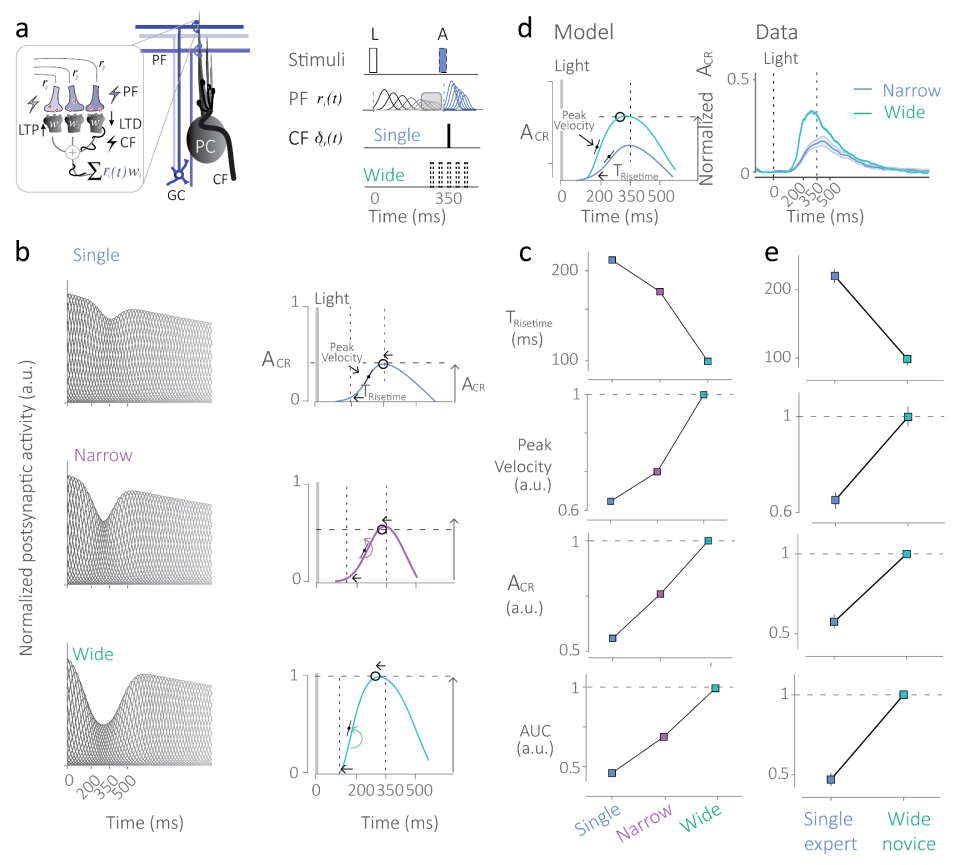
Koppen, J., Bayones, L., Runge, M., Klinkhamer, I., & Narain, D. (2024). Cerebellar encoding of prior knowledge of temporal statistics. bioRxiv (Cold Spring Harbor Laboratory). https://doi.org/10.1101/2024.08.19.608550

A cerebellar cortical mechanism for learning temporal statistics

This study focuses on predictive eyeblink conditioning, investigating how eyelid movements adapt to environmental uncertainty and the probabilities of events. Researchers observed that predictive eyeblinks adjusted according to the timing of stimuli presented. The study highlights the role of cerebellar Purkinje cells, which appear to reflect these statistical variations. Indeed, when Purkinje cells were silenced, it led to a disruption in predictive blinking, indicating the essential function of these cells in temporal statistical learning. Finally, the authors propose a model that emphasizes the significance of synaptic plasticity—specifically long-term depression (LTD) and long-term potentiation (LTP)—in how Purkinje cells encode and react to environmental statistics.

2025.02.25

Proposed by Marianna Lamprou Kokolaki

Chen, J., Leong, Y. C., Honey, C. J., Yong, C. H., Norman, K. A., & Hasson, U. (2017). Shared memories reveal shared structure in neural activity across individuals. Nature neuroscience, 20(1), 115-125.

Regions where recall patterns for a specific movie scene are more correlated between participants than perception-recall patterns, revealing that neural representations during perception are systematically transformed into shared memory representations across individuals.

2025.02.12

Proposed by Nathalie Pavailler

Pavailler, N., Gevers, W., & Burle, B. (2025). Temporal metacognition: Direct readout or mental construct? The case of introspective reaction time. Journal of Experimental Psychology: General.

Better prediction of introspective reaction time (iRT) by taking into account premotor time and motor time.

Participants can access both their decision time and their motor execution time for their iRT judgement.

2025.02.11

Proposed by Clara Diaï

Arrouet, A., Marques-Carneiro, J. E., Marquet, P., & Giersch, A. (2025). Task-specific temporal prediction mechanisms revealed by motor and electroencephalographic indicators. NeuroImage306, 120982.

The sequential effect in implicit timing observed when the movement direction remains consistent (unidirectional) suggesting that external time constraints can be integrated within the motor program but are not necessarily transferred to the next one.